A marketplace listing feels free until you look at the math.
Marketplaces earn their keep in different ways. Some add a fee on the buyer's side, some take a cut or buy at a discount, some charge you to list and surround your listing with competitors. Check each one's current terms. In general a marketplace earns its keep one of three ways: a fee on the transaction, a markup on the price you set, or a system that owns the buyer relationship so the next sale runs through them too.
The breeder side of this is straightforward. Marketplaces work for breeders who do not want to handle the buyer relationship. They cost real money for breeders who do.
This post is the math on what it actually takes to run direct, and the platforms that make it possible without rebuilding your business.
001 / What marketplaces actually cost
How each kind of service makes money, in general terms. Terms change, so check each one's current terms before you decide.
Good Dog. As we understand it, buyers pay a service fee and breeders agree to Good Dog's vetting process and content standards. If the buyer pays more, that can limit your pricing power, and the marketplace holds the first relationship with the lead.
PuppySpot. A different model from a listing site. Check whether it buys puppies from breeders or sells on their behalf, and what you would keep, before you compare it with selling direct. Either way, you should ask what happens to the buyer relationship and your margin.
AKC Marketplace. Listing fees rather than a cut of the sale (the current price is on AKC's site). Lead quality can be lower because the page surrounds your listing with competitor litters.
Generic classifieds (Hoobly, Craigslist, NextDayPets). Mostly free or low listing fees. Scam risk is real on open classifieds; screen every buyer.
Pick any of those and the trade is the same. You give up part of the sale, or the buyer relationship, or both, in exchange for traffic and trust the marketplace has already built.
For some breeders that trade is worth it. New breeders with no website and no audience. Breeders who want zero buyer screening work. Breeders selling into a market where the marketplace is the only place buyers look.
For most working breeders, the math gets worse the longer you do it, because the buyer relationship is the breeder's, not the marketplace's.
002 / What "direct" actually means
Selling direct does not mean refusing to use any tool. It means owning the buyer relationship, the price, and the brand.
The components of a direct setup:
- A website you control. Domain in your name. Hosting you can move.
- A way to take inquiries that does not require the marketplace's form.
- A contract you control. Pricing you control.
- A way to take payment that does not require the marketplace's payment processor.
- A way to handle the waitlist and the buyer comms.
Each of those used to require a separate tool. Today, most of them can be handled by one or two pieces of software, with no marketplace involvement at all.
For the website piece, best website builders for dog breeders compares the options.
003 / The stack that works
The minimum viable direct-sales stack for a working breeder.
One. A website built on a system you own. WordPress, Webflow, Squarespace, Kennel Press, or a custom build. Not a marketplace listing page. The site is the buyer's first impression and the source of every search-driven lead. The 5 things a breeder website needs post covers what the site itself has to include.
Two. An inquiry form that captures buyers cleanly. Embedded on the available animals page, the contact page, and the home page. Goes into a real waitlist tool, not your email inbox.
Three. A pricing page (or available animals page with prices). Marketplaces normalize hiding pricing behind a contact form. Buyers searching direct expect to see prices. List them. Pricing transparency is a trust signal and an SEO advantage.
Four. A contract and deposit system. The contract goes out via DocuSign or HelloSign. The deposit gets collected via Stripe, PayPal or Square. Both happen before the buyer goes on the waitlist for a specific animal.
Five. A waitlist tool. Covered in detail in the puppy waitlist software post. Pick one that actually handles the buyer pipeline. Spreadsheet works until it breaks.
Six. Email and SMS for ongoing buyer comms. Most breeders run this through Gmail and their phone. That works at small scale. At larger scale, a tool that templates the recurring messages saves hours per week.
That is the full stack. Anywhere from $0 to $200 a month depending on how much you self-host vs. buy.
004 / The platforms that bundle the stack
You can build the stack from 6 separate tools or pick tools that cover several of them. Prices here are from each company's public pages as we understood them at the time of writing; confirm on the vendor's page.
HoneyBook or Dubsado. Generic service business CRMs. Handle the inquiry, contract, and payment side well. Do not know what a litter is. Pricing in the $36 to $40/mo range.
Shopify or WooCommerce with custom workflows. E-commerce platforms bent into a breeder workflow. Work for breeders comfortable with technical setup. Cost varies wildly based on apps.
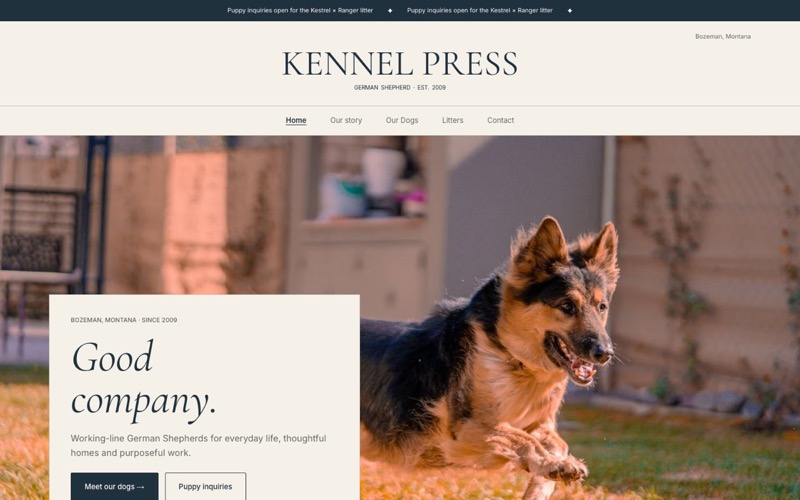
Kennel Press. I build this, so weigh it accordingly. It is the website piece, not a bundle: designed templates, a page for every dog and litter, and an inquiry form that emails you which dog or litter the buyer asked about. The Free plan stays online with no trial clock, and Pro is $39 a month. It does not take deposits, hold contracts or run a waitlist, so those stay in the tools above or a spreadsheet.
A custom build. For breeders who want everything tailored. Costs in the $2,000 to $8,000 range one-time. Detailed pricing in the dog breeder website cost post.
The right choice depends on volume, technical comfort, and budget. For most working breeders running 2 to 6 litters a year, a website that does the public side well plus a CRM like HoneyBook or a spreadsheet for the pipeline hits the right balance.
005 / The piece marketplaces hide
The biggest trade-off marketplaces ask for is not the percentage. It is the data.
When you sell through a marketplace, the marketplace owns the buyer's email, the buyer's history, and the buyer's next purchase decision. You get a one-time transaction. The marketplace builds a customer base that includes your buyer.
When you sell direct, the buyer is yours. They get your follow-up emails. They are the first person you contact for your next litter. They refer their friends to you, not to the marketplace.
This compounds over years. A breeder running direct for several years builds a list of past buyers, some of whom may buy again or refer someone. A breeder who relies only on a marketplace may end up with few or none of those buyers in their own list, depending on the marketplace's terms and on whether the breeder collects contact details themselves.
The percentage of the sale is the small cost. The compounding loss of the buyer relationship is the real one.
006 / What this looks like in practice
Take a breeder doing 4 litters a year. Compare two paths and fill in your own numbers.
Marketplace path:
- Revenue per year: your asking price times your puppies, less whatever fees the marketplace charges you or your buyer, and any price you cut to cover the buyer's all-in cost.
- Buyer list at end of year: depends on the marketplace's terms and on whether you collect contact details yourself.
Direct path with a custom website:
- Year 1: the same revenue with no marketplace fees, less the one-time cost of the site and the monthly cost of your tools.
- Buyer list at end of year: every buyer is a contact you own.
Year 1 can be roughly a wash once you count the site. After that you do not repeat the site investment, and the buyer list compounds: past buyers refer friends and come back for the next litter, so the list can become your main lead source over a few years. It is a trend, not a promise.
The trade is the time investment. Direct means handling inquiries, applications, contracts, deposits, follow-ups. The platforms bundle most of that. The percent of week-to-week time is real but the dollar return is meaningful.
007 / What to do this week
Step 1. Count what marketplaces are costing you. Total marketplace fees, the discount a buy-from-breeder service takes, or estimated lower retail to account for buyer-paid fees. Multiply by litters per year. The number is usually bigger than expected.
Step 2. Pick the stack. For most breeders, the answer is the website you already have or can build, a spreadsheet or low-cost CRM for the pipeline, Stripe for payments, and a contract written from the contract template post. Total under $100/mo at the high end.
Step 3. Run direct for one litter. Keep the marketplace listing if you need the safety net for that litter. Pull the marketplace listing for the next one once direct is working.
Most breeders who switch to direct do it gradually. The first litter direct is the proof. Litters 2 and 3 are the migration. By litter 4 the marketplace is gone and the buyer list is doing the work.
For the longer version of why this matters strategically, the selling animals online lessons post is the post-mortem from my own switch years ago.