Facebook technically prohibits animal sales on Marketplace. The policy has been in place for years, and enforcement is inconsistent enough that breeders have continued using it anyway. Some breeders build their entire sales operation around Facebook groups and posts, connecting with thousands of followers and moving litters through DMs and comment threads.
That works until it does not.
If you want to sell puppies online at any meaningful scale or with any real stability, you need to understand every channel available to you. You are one policy enforcement sweep, one account report, or one algorithm change away from losing access to your audience if Facebook is your only strategy. The breeders who build diversified online sales operations, using their own website as the hub and marketplaces and social media as traffic sources, are the ones who have sustainable programs.
This guide covers every real option for selling puppies online, what each one costs, what each one is actually good for, and how to build a setup that does not depend on any single platform staying cooperative.
Why Facebook Is Risky as Your Only Sales Channel
Facebook's Community Standards explicitly prohibit the sale of animals on Facebook Marketplace. The platform has stated this policy clearly, though enforcement has been uneven enough that many breeders have operated there for years without issue. That unevenness is itself the problem: you cannot build a business on a platform whose rules you are technically violating and whose enforcement is unpredictable.
"Facebook jail" is real. Breeders lose accounts, get posts removed, have their groups taken down, and get blocked from messaging without warning and without clear recourse. When that happens, you lose access to your entire follower list. The people who have liked your page for three years, who were waiting for your next litter announcement, who planned to contact you when you had available puppies: all of that relationship equity disappears. You cannot export that list. You cannot contact those people through another channel. They are gone.
Facebook posts give you little SEO value you control. A post you publish today about your available litter may or may not be found by search engines, and you do not control how long it stays visible. It appears in your followers' feeds for a day or two, then it is buried. You are not building anything with that content. Posts you write for Facebook build little long-term search visibility you own.
The algorithm hides posts from followers constantly. Organic reach on Facebook business pages has declined steadily for years. Many breeders report that posts reach only 5 to 10 percent of their page followers without paid promotion. If you have 2,000 followers, that means 1,800 of them probably did not see your litter announcement.
None of this means you should stop using Facebook. It means you should stop letting it be your only channel.
The Marketplace Options
There are several established marketplaces where buyers search specifically for puppies and dogs. Each has different costs, different audiences, and different levels of buyer vetting.
AKC Marketplace
AKC Marketplace is the most recognized name in dog sales. Listing costs money and the current price is on AKC's site. The credential is real: AKC Marketplace requires AKC registration for all listed puppies, which filters out a significant portion of casual sellers and backyard breeders.
The benefit is credibility. When a buyer sees your litter on AKC Marketplace, they know the puppies are AKC registerable. For breed purists and buyers who specifically want registration papers, AKC Marketplace is one of the first places they look.
The limitation is volume. You are one of thousands of breeders on the platform, often competing in the same breed and similar geography. Your listing appears alongside dozens of others for the same breed, and differentiation comes down to photos, pricing, and reviews. It is a useful discovery channel, not a complete sales solution.
The platform also requires AKC registration, which excludes breeders working with breeds that do not have AKC recognition, mixed breed programs, or breeders who choose not to participate in AKC registration for other reasons.
Good Dog
Good Dog is a puppy platform that, as we understand it, vets breeders and charges buyers a service fee rather than taking a cut from the breeder. Check its current terms before you decide.
The vetting process is the key distinction. Good Dog reviews applications from breeders before approving them. They look at health testing, living conditions, and program practices. Getting approved is not automatic, and that selectivity is exactly why buyers trust the platform. A Good Dog listing signals to buyers that the platform has already done some baseline screening.
The downside is the same as any marketplace: you do not control the format. Your listing lives inside Good Dog's design, Good Dog's buyer experience, and Good Dog's search algorithm. When a buyer finds you through Good Dog, they are Good Dog's customer first and yours second. If Good Dog changes its policies, pricing structure, or ranking algorithm, your visibility changes with no input from you.
Good Dog is a strong discovery channel and worth listing on. It should not be your only channel.
Puppies.com
Puppies.com is free for buyers and has broad reach across breeds and locations. Direct messaging makes the buyer contact process straightforward.
For breeders, Puppies.com works as a volume play. You can reach a large audience, so it may be worth listing on, particularly for breeds with broad popular appeal. Check its current terms and vetting before you decide.
Your Own Website Is the Long-Term Play
Every marketplace listed above has the same fundamental limitation: the traffic belongs to them, not to you. When a buyer discovers you on Good Dog, the relationship starts with Good Dog. The search ranking Good Dog has built for "Golden Retriever breeder Ohio" is theirs. Your presence there is rented.
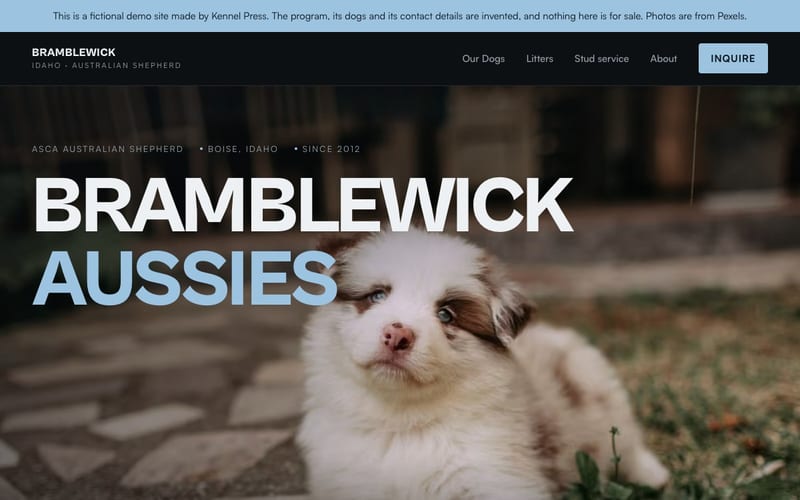
Your own website is different. The traffic you earn through search belongs to your site. The buyer who finds you by searching "health tested Bernedoodle breeder Colorado" and lands on your website is your buyer from the first click. You control the full experience: how your dogs are presented, what story your program tells, how the inquiry process works, how deposits are taken.
This matters more as your program grows. A breeder website that search engines can read well is a durable asset. Search is slow to build and nobody can promise a result, but a site does not charge you per listing the way a marketplace does.
You also control the buyer experience end-to-end. Buyer application forms that ask the right qualifying questions. A waitlist system that manages expectations about availability. Online deposit collection through Stripe or PayPal with automatic receipts. Litter update emails that go directly to interested buyers rather than hoping an algorithm shows them your post.
For a deeper dive into what a breeder website needs to do, read how to build a breeder website and best website builders for dog breeders in 2026.
How to Set Up Your Own Puppy Sales Pipeline
Building a self-contained online sales pipeline does not require technical expertise. Here is the practical six-step setup that works for most breeding programs.
Step 1: Get a website. Not a Facebook page. Not a free landing page. A real website with your own domain name that you own and control. If you are not sure where to start, read how to build a breeder website. Your website is the hub for everything else in this list.
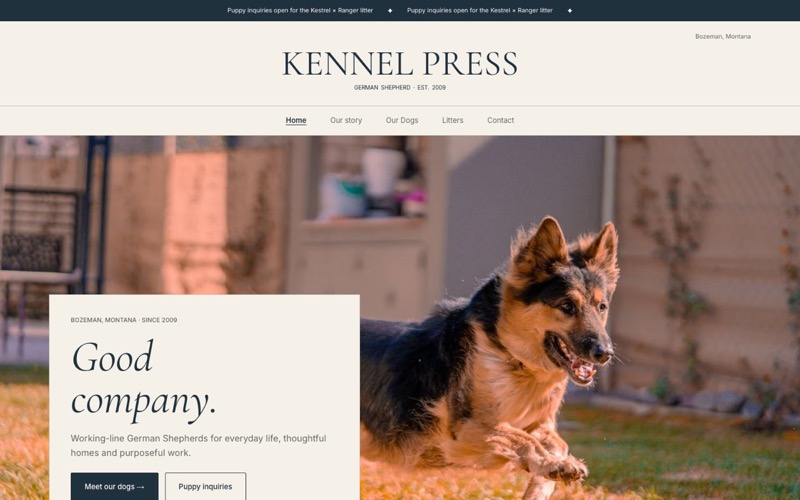
Step 2: Create individual pages for each puppy or litter. A single "Available" page with all puppies listed together is far less effective than individual litter pages or individual puppy profiles. Each dedicated page can rank on Google for specific searches and gives buyers a complete picture of a specific animal or litter rather than a crowded list. Include photos, parent information, health testing, birth date, pricing, and availability status. Kennel Press, which I build, gives every dog and every litter its own page for this reason.
Step 3: Build a buyer application form. Not a contact form. An application that collects housing situation, experience with the breed, timeline, intended use, and any breed-specific qualifying questions. This pre-qualifies buyers before you spend time on a phone call, and it signals to serious buyers that you are running a structured program.
Step 4: Set up a deposit system. Stripe and PayPal both integrate cleanly with most website platforms and handle deposit collection professionally. Buyers who send a formal deposit through a payment processor feel more committed than those who venmo you informally. You also have a transaction record that protects both parties.
Step 5: Use email, not just text. Build an email list of people who have inquired about your dogs. When a new litter is planned, send an announcement. When puppies are available, send an availability notice. Text messages are personal and work for buyers you already know, but email scales. A list of 200 interested buyers who receive a litter announcement on the day reservations open is a genuine sales asset.
Step 6: Use social media to drive traffic to your site, not as the destination. Post litter announcements on Facebook and Instagram, but always include a link to your website where buyers can get the full picture and fill out an application. Your social media posts are traffic drivers, not the destination. Every post should point back to your hub.
What About Craigslist and Classified Sites?
You can sell puppies on Craigslist. People do it. But the buyers attracted to Craigslist listings for dogs are disproportionately price-focused. They are comparing your health-tested puppy against much cheaper listings in the same search results. The context of Craigslist does not frame you as a serious breeder; it frames you as a seller among sellers.
For working dogs under $500, livestock guard dogs, or common breeds with broad price ranges, classified sites serve a purpose. For programs where you have invested significantly in health testing, showing, and building bloodlines, the buyer profile on Craigslist is not your buyer. Your time is better spent building search visibility for the buyers who are specifically looking for a reputable program. Read selling animals online: what I learned for more on matching your channel to your buyer.
The Ideal Setup
The breeders who run the most stable, low-stress online sales operations are not relying on any single channel. They have built a stack that covers discovery, trust-building, and conversion at every stage.
Your own website is the hub. It is the page search engines can send breed-specific searches in your region to. Every buyer inquiry goes through your application form. Deposits are collected through your payment processor. Litter updates go to your email list.
One or two marketplaces for discovery. AKC Marketplace if you are AKC focused. Good Dog for credibility signaling. These platforms send buyers who are actively searching to your listing, and you direct them to your website for the full picture and the application.
Social media for awareness and community. You post updates, share puppy photos, and maintain a presence for your followers. Every post that mentions available animals links back to your website. You are building an audience, not running a sales channel.
An email list for direct communication with interested buyers. When you have availability, an email to your list is the first call before a public announcement. This rewards buyers who have been following your program and fills litters quickly without dependence on an algorithm showing your post to the right people.
The goal is a setup where your sales do not depend on any single platform behaving the way it did last month. Kennel Press covers the first layer of it, the website and its inquiry form. It does not take deposits or manage waitlists, so those stay in their own tools.
FAQ
Is it legal to sell puppies online?
Yes, selling puppies online is legal in the United States, though state and local regulations vary. Some states require a breeder license once you exceed a certain number of litters per year or breeding females. Federal licensing under the USDA's Animal and Plant Health Inspection Service (APHIS) can also apply, depending on factors such as the number of breeding females and whether you sell sight-unseen, and the rules change. Ask APHIS and your state and local regulators what applies to you. Check your specific state's laws before scaling your operation: states like California, Virginia, and Illinois have enacted regulations in recent years that affect both the sale of puppies and the conditions required to breed. Reputable platforms like Good Dog and AKC Marketplace have compliance resources that can point you toward your state's current requirements.
What is the best website to sell puppies?
There is no single best answer because the right platform depends on your breed, your program's reputation, and who your buyers are. Good Dog is the strongest overall marketplace for buyers who are seriously vetting breeders: the platform's reputation for screening creates a buyer pool with higher intent and better fit. AKC Marketplace is the right call if your buyers are specifically seeking AKC-registered dogs and the registry credential matters to your market. Your own website is the best long-term investment because the search visibility you earn is yours rather than rented space on someone else's platform. The ideal setup uses all three: your site as the hub, marketplaces for discovery, and social media to drive traffic back to your site.
How much does it cost to sell puppies on AKC Marketplace?
AKC Marketplace charges a listing fee, and the current price is on AKC's site. To list on AKC Marketplace, your litters must be AKC registered, which requires AKC membership and registration fees for the litter itself. Check AKC's current fee schedule for both. As far as we know it takes no cut of the sale, but confirm its current terms before you rely on that.
Do I need a website to sell puppies or is Facebook enough?
Facebook alone is not enough for a serious breeding program, and it carries real risk as your primary channel. Facebook's Community Standards technically prohibit animal sales on Marketplace, enforcement is unpredictable, and you have no ownership over your audience. If your account is restricted or your posts are removed, you lose access to your followers immediately with no way to reach them through another channel. Your own website gives you search visibility you own, full control over the buyer experience, and an asset that does not depend on what any social platform does with its policies. Facebook is a useful traffic driver, not a foundation.
How do I take deposits for puppies online?
Stripe and PayPal are the two most common options for online deposit collection, and both work well for breeding programs. Stripe integrates cleanly with most website platforms and processes credit and debit cards professionally with automatic receipts. PayPal is familiar to most buyers, and it has buyer and seller protection programs with conditions and exclusions, so confirm that your exact transaction qualifies. Set up a payment link for your standard deposit amount, include it in your buyer confirmation email after an application is approved, and keep a record of each deposit tied to the specific puppy or litter it applies to. Be clear in writing about your deposit policy: whether it is refundable, whether it transfers to a future litter, and what it guarantees the buyer. A clear, professional deposit process signals that you are running a structured program and reduces disputes later.